
Key Takeaways
- BUSY and Marg ERP both support billing, GST invoicing, accounting, inventory, reports, e-invoicing, e-way bills, and mobile access.
- BUSY has been in the Indian accounting software market for over 30 years and is used by 6,00,000+ businesses across India.
- BUSY is a strong fit for GST reconciliation, ITC review, approval workflows, mobile reporting, inventory traceability, and accounting controls.
- For businesses looking for a Marg ERP alternative, BUSY is worth evaluating when GST accuracy, stock visibility, and accounting-led control are key priorities.
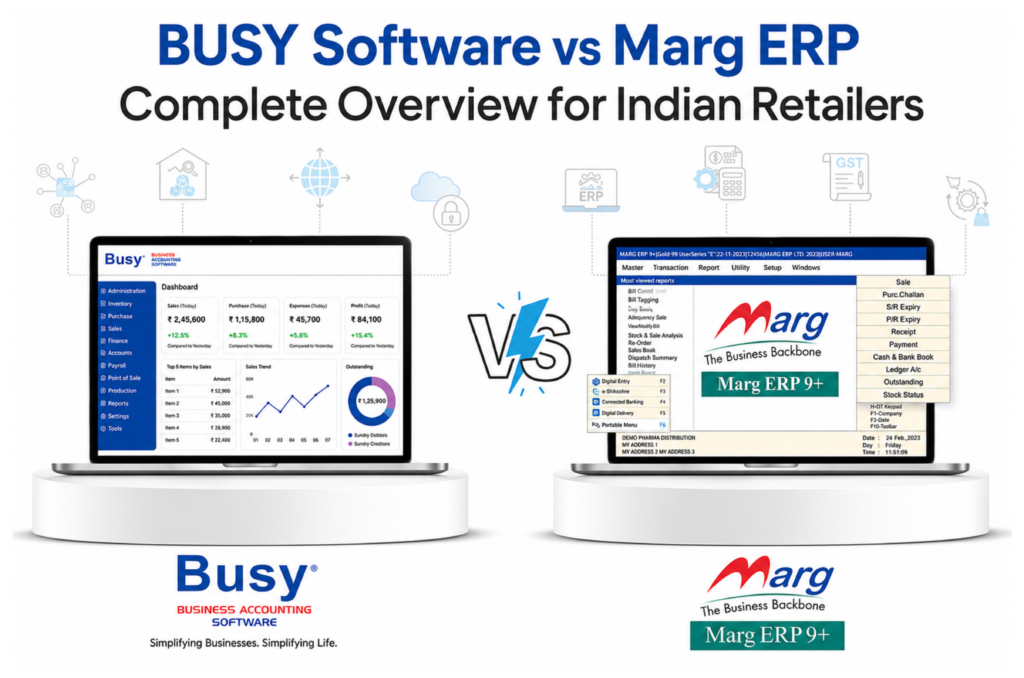
BUSY and Marg ERP are both established accounting ERP solutions used by Indian businesses for billing, accounting, GST, inventory, reporting, and business management. Both are used by SMEs, traders, distributors, retailers, and growing businesses that need more than basic billing software.
BUSY has been in the Indian accounting software market for over 30 years and is used by 6,00,000+ businesses across India. This gives it a strong presence among Indian businesses evaluating accounting, GST, inventory, and reporting software.
BUSY is more relevant for businesses that need stronger GST reconciliation, accounting controls, approval workflows, mobile reporting, and inventory traceability in a single system. Instead of listing every feature, this comparison looks at how BUSY and Marg ERP differ in daily use, business control, compliance, and overall fit.
Quick Comparison: BUSY vs Marg ERP
| Area | BUSY | Marg ERP |
| GST invoicing, e-invoice and e-way bill | Strong GST-ready billing with e-invoice, e-way bill, GST reports, and connected compliance workflows in one system | GST invoicing, e-invoice, and e-way bill features are available |
| GST reconciliation | Stronger fit for GST reconciliation, ITC review, GSTR comparison, and books vs portal matching | Common GST workflows are available, but reconciliation depth should be checked during the demo |
| Accounting control | Better suited for businesses that need structured accounting, ledgers, approvals, audit trail, user rights, and financial visibility | Offers accounting features, but many businesses evaluate it more for operational and inventory workflows |
| Inventory management | Strong inventory control with stock traceability, serial/warranty tracking, item-level reports, multi-godown, and size/variant handling | Strong for pharma, distribution, barcode, batch, expiry, and stock workflows |
| Mobile app | Useful for business owners to check reports, approvals, e-way bills, e-invoicing, and key voucher workflows on the go | Useful for field sales, ordering, collections, stock, and owner reports |
| Business controls | Strong for approval workflows, user permissions, dashboards, logs, and admin-level control across teams | Offers user controls and reporting; exact depth may vary by edition and use case |
| Best fit | Businesses that want accounting depth, GST compliance, inventory control, approvals, and multi-user visibility in one connected system | Businesses focused on pharma, retail distribution, field-sales operations, and stock-heavy workflows |
| Overall positioning | Better choice for businesses that want accounting, GST, inventory, and business control together | Better explored where pharma, distribution, or field-sales workflows are the main priority |
GST Compliance and Reconciliation
GST is one of the most important areas in the BUSY vs Marg ERP comparison. Both platforms can support regular GST work, including GST invoicing, return-related reports, e-invoicing, e-way bill generation, HSN summaries, and GST records. For many businesses, this is enough for day-to-day billing and compliance.
The difference becomes clearer when GST work goes beyond basic return preparation. Businesses that regularly deal with ITC mismatches, supplier follow-ups, GST notices, multiple GSTINs, or month-end reconciliation pressure need more detailed visibility between books, GSTR-2A, GSTR-2B, and GSTR-3B.
This is where BUSY has a stronger fit. It is useful for businesses that need GST reconciliation, ITC review, supplier mismatch tracking, IMS, Table 8A-related checks, and return-related workflows such as GSTR-6, GSTR-7, or ITC-04, where applicable.
Marg ERP also supports GST billing and common compliance workflows. Businesses considering Marg ERP should check the exact reconciliation depth, GST return workflows, and edition-level availability.
Billing, Inventory, and Stock Controls
Both BUSY and Marg ERP can handle regular billing, purchases, sales, stock tracking, and inventory operations. The real difference is in the type of inventory workflow a business needs.
Marg ERP has a strong presence in pharma, FMCG, retail, and distribution. It is useful for businesses where batch, expiry, barcode, stock movement, ordering, collections, and field-sales workflows are important. This makes it relevant for businesses that depend heavily on operational stock movement and sales-team activity.
BUSY also supports billing and inventory needs, including batch-wise and MRP-wise stock, multi-godown inventory, alternate units, schemes, price lists, challans, item-wise discounts, party-wise pricing, and stock reports.
BUSY becomes more useful when inventory needs to stay closely linked with accounting and control. For example, businesses that track products by serial number, warranty date, size, model, item specifications, party-wise item codes, or detailed stock categories may find BUSY more suitable.
Mobile Access and Approval Workflows
Mobile access is now important for owners, accountants, sales teams, and managers. But not every business needs mobile access for the same reason. Marg ERP has useful mobile workflows for field sales, retailer ordering, collections, outstanding, stock, invoices, and owner-level reports. This makes it relevant for distribution-led businesses and teams that depend on salesmen, dealers, or retail ordering networks.
BUSY’s mobile app is useful for owners, accountants, or managers who need access to reports, approvals, invoices, receipts, payments, e-way bills, and e-invoicing on the go. It also supports approval-based workflows, which can help when the owner or senior team wants control without sitting at the main system. For a business comparing BUSY vs Marg ERP, mobile access should be judged by actual team usage, not just by whether an app is available.
Business Controls and Reporting
Growing businesses need more than invoicing. They need control over who can enter, approve, edit, freeze, view, or report data. This becomes important when multiple users, accountants, branch teams, or managers work in the same system.
Both BUSY and Marg ERP offer business controls, reporting, and user-level workflows. However, the depth and availability of these controls should be verified for the selected edition or module.
BUSY is stronger for businesses that want accounting-led control. It supports workflows such as user rights, approval controls, configurable dashboards, admin-level logs, voucher and master approvals, and multi-company or multi-branch visibility, depending on the edition and setup. It also supports useful accounting reports, including ledger reconciliation, P&L, Balance Sheet, comparative reports, and other business reports that help owners and accountants review performance and compliance together.
E-commerce and Additional Business Workflows
Businesses selling through online marketplaces need to check e-commerce workflows carefully. Order sync, payout reconciliation, return handling, and accounting entries can become difficult when online and offline sales are managed separately.
BUSY Recom supports e-commerce reconciliation workflows for platforms such as Amazon, Flipkart, and Shopify. This can help marketplace sellers manage order reconciliation, payment matching, returns, and accounting more systematically. Marg ERP also has ordering and e-commerce-related workflows, including MargMart and ERP-to-ERP ordering options.
Before choosing either platform, online sellers should check which marketplaces are supported, how payout reconciliation works, how returns are handled, and whether online and offline books can be managed together.
When BUSY May Be a Better Fit
BUSY may be a better fit when your business needs stronger control over GST, accounting, stock, and approvals within a single system. It is worth evaluating if your team regularly handles ITC mismatches, supplier reconciliation, multiple companies, approval workflows, serial number tracking, warranty-based stock, or owner-level reporting.
BUSY is also suitable for businesses where the accountant, owner, and team members need controlled access to the same business data without losing visibility over edits, approvals, reports, or compliance work. This does not make Marg ERP a weak option. It simply means BUSY becomes more relevant when GST reconciliation, accounting control, inventory traceability, and approval visibility are major priorities.
Before choosing between BUSY and Marg ERP, businesses should test both platforms with their real workflows instead of relying only on feature lists. Check how each software handles GST reconciliation, billing, stock tracking, mobile access, user permissions, reports, data backup, and migration support. This gives a clearer view of which platform fits daily operations better.
Conclusion
BUSY and Marg ERP are both established accounting ERP solutions used by Indian businesses for billing, accounting, GST, inventory, reporting, and business management. For businesses evaluating MSME ERP software, both platforms are commonly considered by SMEs, traders, distributors, retailers, and growing businesses that need more than basic billing software.
BUSY is better suited for businesses where GST reconciliation, ITC tracking, accounting visibility, approval controls, inventory traceability, and mobile reporting are more important. For businesses comparing BUSY software vs Marg ERP, the right choice depends on GST workload, inventory complexity, mobile usage, team structure, and control requirements. If compliance accuracy and accounting control are major priorities, BUSY is worth evaluating closely.
Frequently Asked Questions
Can a business switch from Marg ERP to BUSY?
Yes, a business can switch from Marg ERP to BUSY, but the move should be planned carefully. Before migration, the business should review masters, ledgers, opening balances, stock details, vouchers, GST records, and important reports. It is also useful to match key reports in both systems before fully shifting daily work to BUSY.
What should be checked before moving from Marg ERP to BUSY?
Businesses should check data migration scope, edition-level features, user access needs, stock tracking requirements, GST workflows, report formats, backup process, and training support. This helps avoid gaps after switching and ensures the new setup matches actual daily operations.
Will old Marg ERP data move automatically to BUSY?
Not always. Data migration depends on the format, quality, and structure of the existing data. Some data may need cleaning or mapping before it can be imported into BUSY. Businesses should confirm what can be migrated, what needs manual review, and what reports should be verified after migration.
How should a business test BUSY before replacing Marg ERP?
The demo should be based on real business workflows, not only standard feature lists. Businesses should test sample sales bills, purchase entries, stock items, GST reports, user roles, approval needs, and management reports. This gives a clearer idea of how BUSY will work in daily use.
Will the team need training after switching to BUSY?
Yes, some training is usually helpful. Even if the team already uses accounting software, BUSY may handle menus, reports, user rights, GST workflows, and inventory settings differently. Short role-based training for accountants, billing teams, managers, and owners can make adoption smoother.
Can BUSY be a better fit than Marg ERP for accounting-led businesses?
BUSY can be a better fit when the business wants accounting, GST, inventory, approvals, and reports to stay closely connected. Marg ERP may still be relevant for businesses with pharma, retail distribution, or field-sales-heavy workflows. The right choice depends on the business’s actual operating needs.
How long does it take to shift from Marg ERP to BUSY?
The time required depends on data size, number of users, inventory complexity, GST records, branches, and custom requirements. A small setup may move faster, while businesses with detailed stock, multiple users, or several years of data may need more planning, testing, and training.
Should a business stop using Marg ERP immediately after moving to BUSY?
It is better to avoid an abrupt switch. Businesses should first complete migration, verify opening balances, compare key reports, train users, and test daily workflows. Keeping the old system available for reference during the initial transition can help reduce confusion.